REVIEW · JAIPUR
3 Days: Private Guided Tour Of Jaipur & Agra With Drop At Delhi
Book on Viator →Operated by Unseen Tours and Travels · Bookable on Viator
Three days, two empires, one smooth ride. What makes this tour work so well is the private, air-conditioned car plus local guides who focus on the key sites without turning it into a rushed checklist. I like that you get two nights of accommodation included, and I really like the add-on of a traditional dinner with a local family in Jaipur. One thing to plan for: the monument entry tickets are extra, so your final cost won’t be exactly the headline price.
On Day 1 you’ll tackle Jaipur’s most famous architecture—Amer Fort, City Palace, Jantar Mantar, and the viewpoints around Hawa Mahal—then move deeper into the Mughal world on Day 2 and 3 with Fatehpur Sikri, the Taj Mahal, Itmad-ud-Daula, and Agra Fort. The pacing is built for comfort: hotel pickup, bottled water, and guides in Jaipur, Fatehpur Sikri, and Agra, followed by a drop in Delhi at your hotel or the airport.
In This Review
- Key things to know before you go
- Amer Fort and the Classic Jaipur Circuit on Day 1
- Jal Mahal: A quick look with a good payoff
- City Palace: Where the story stays in Jaipur
- Jantar Mantar and Hawa Mahal: Two UNESCO-level landmarks in one sweep
- The behind-the-scenes dinner moment
- Day 2’s jump: Chand Baori step well to Fatehpur Sikri and the Taj Mahal
- Taj Mahal: your main event, with entry fees to plan for
- Agra Fort and Itmad-ud-Daula on Day 3 before the Delhi drop
- Drop at Delhi hotel or airport
- Included hotels, guides, and AC transport: why this setup feels easier
- Two included breakfasts and one included dinner
- Price and value: does $187 per person make sense?
- What I’d pack and how I’d pace it
- Who this tour is best for
- Should you book this Jaipur and Agra private tour?
- FAQ
- How long is the Jaipur and Agra tour?
- Is pickup included?
- Is this tour private or shared?
- What’s included in the price besides the tour?
- Are monument entry fees included?
- Where do I get dropped off at the end?
- Does the tour include transport between cities?
- What time is the tour usually booked?
- What’s the cancellation policy?
Key things to know before you go
- Two hotel nights included (your selected 3/4/5-star option), so you’re not hunting for places to stay mid-trip
- A real Jaipur family dinner is part of the program, not just a restaurant stop
- Local guides in three key locations (Jaipur, Fatehpur Sikri, Agra) to help you understand what you’re seeing
- Most major sights included by name, from Amer Fort to Jantar Mantar to the Taj Mahal
- Monument entry fees are on you, paid directly at the sites
Amer Fort and the Classic Jaipur Circuit on Day 1
Day 1 is where you get your bearings in Jaipur. You’ll start with Amer Palace (Amer Fort), the big one. It sits up on a hill about 11 kilometers from Jaipur city, and it’s the kind of place where you feel the scale even before you step inside. Plan for a slow climb—there are changes in level and plenty to look at—so that 1 hour 30 minutes feels about right if you want to take photos and still keep your energy.
Amer Fort is also one of those sites where a guide really pays off. Without context, it can become just “lots of rooms and courtyards.” With a local guide, you start to notice how the fort’s layout supports defense and royal life at the same time. And because this tour keeps everything together, you’re not spending your day figuring out transit between widely separated locations.
You can also read our reviews of more guided tours in Jaipur



Jal Mahal: A quick look with a good payoff
After Amer, you’ll stop at Jal Mahal, the palace sitting in the middle of Man Sagar Lake. This stop is short—around 15 minutes—so I treat it as a photo-and-walk moment, not a deep visit. Even if you don’t go inside (and the tour doesn’t list entry here), the viewpoint is worth it because it shows a different side of Jaipur: the city’s royal architecture isn’t only on hills and in forts, it also plays with water.
City Palace: Where the story stays in Jaipur
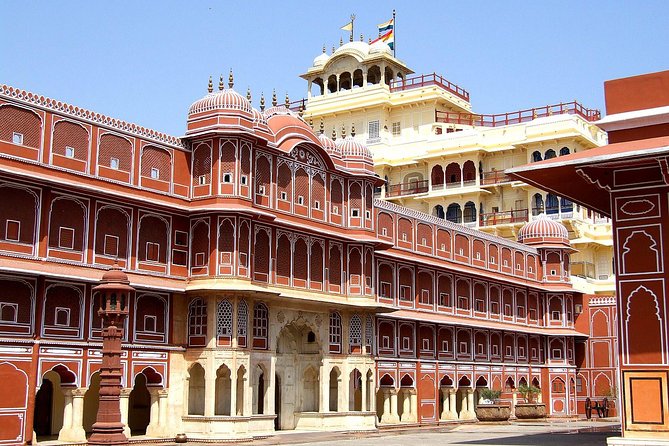
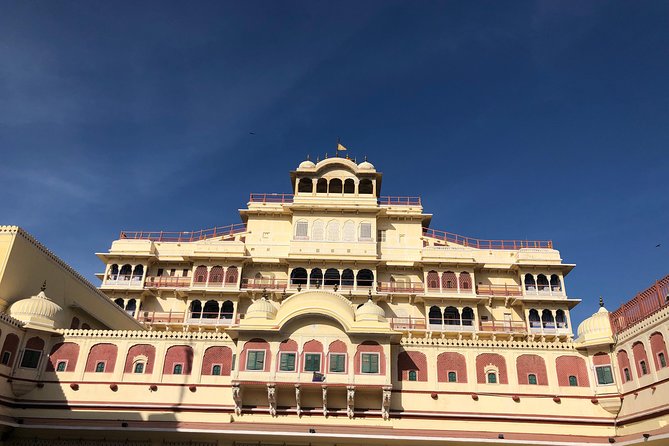
Next comes City Palace of Jaipur. The tour allots about an hour here, which is a comfortable window for a guided experience. City Palace isn’t just one building—it’s a whole complex tied to the city’s rulers. The timing works well because you’ve already seen Amer, so now you’re comparing royal spaces: how the court shifted from Amber to Jaipur, and what changed when the power center moved in 1727.
This is also a good stop for practical reasons. You’ll have a chance to understand the city’s layout and symbols, which makes later stops—especially the more “visual” landmarks—feel less random.
Jantar Mantar and Hawa Mahal: Two UNESCO-level landmarks in one sweep
By the time you reach Jantar Mantar, you’ve already covered forts and palaces. That matters, because Jantar Mantar feels different. It’s a collection of nineteen architectural astronomical instruments built under Sawai Jai Singh II, completed in 1734. The big draw is the world’s largest stone sundial, and it’s also a UNESCO World Heritage site. With a guide, it’s easier to connect what looks like unusual stonework to actual measurements of time and celestial movement.
You get about 40 minutes—enough time to understand how to read at least the main instruments, even if you don’t go full nerd mode (you don’t have to). If you’re the type who likes details, this is where you’ll want to slow down and ask questions. If you’re not, you’ll still come away with that sense of Jaipur as a city that treated science as a public project.
Then it’s Hawa Mahal (Palace of Wind). You’ll spend about 15 minutes here, which is basically for viewing and quick photos. The palace is made of red and pink sandstone and runs along the edge of City Palace, extending toward the Zenana, the women’s chambers. Even with a short stop, it’s memorable because it’s instantly recognizable and visually patterned. I like short Hawa Mahal visits because they don’t punish you with walking time, but they still give you the signature Jaipur face.
The behind-the-scenes dinner moment
Day 1 isn’t only sightseeing. You also include a traditional dinner with a local family in Jaipur. This is the kind of experience that turns a tour from “I saw things” into “I understood how people live.” In one standout scenario, the tour owner even joined guests for dinner with his family, adding that extra personal layer that you don’t get with a standard restaurant meal.
This part is also a reminder of what a private guide setup can do: instead of only handling monuments, the program helps you connect with everyday culture at a slower pace.
You can also read our reviews of more private tours in Jaipur




Day 2’s jump: Chand Baori step well to Fatehpur Sikri and the Taj Mahal
Day 2 is a classic “Rajasthan-to-Mughal” bridge day. You start with Chand Baori (Step well) at Abhaneri. The stop is brief—around 15 minutes—but step wells are one of those places where a short visit works because the main experience is the structure itself. Chand Baori is known for the way the steps descend and form a striking geometry, and it’s the kind of sight you’ll remember long after you leave the grounds.
From there, you head to Fatehpur Sikri, a small city west of Agra founded by a 16th-century Mughal emperor. You’ll have about 1 hour 30 minutes here, with entry listed as free for the stop. Fatehpur Sikri is red sandstone architecture concentrated around the center, so it helps to have a guide to point out what to look for rather than wandering randomly.
Focus on the major named elements as you go:
- Buland Darwaza gate, marking the entrance area near the mosque zone
- Jama Masjid, where the complex starts to make more sense as a religious center
- The marble Tomb of Salim Chishti, which gives you a spiritual anchor for the visit
- Diwan-E-Khas hall, known for a carved central pillar
- The Jodha Bai Palace style blend and the Panch Mahal views
If you like places that feel cinematic, Fatehpur Sikri is that. Even without extra bells and whistles, it has the “history you can see” feeling. And because your itinerary strings it between Jaipur and Agra, you don’t feel like you’re just commuting—you feel like you’re traveling with a narrative.
Taj Mahal: your main event, with entry fees to plan for
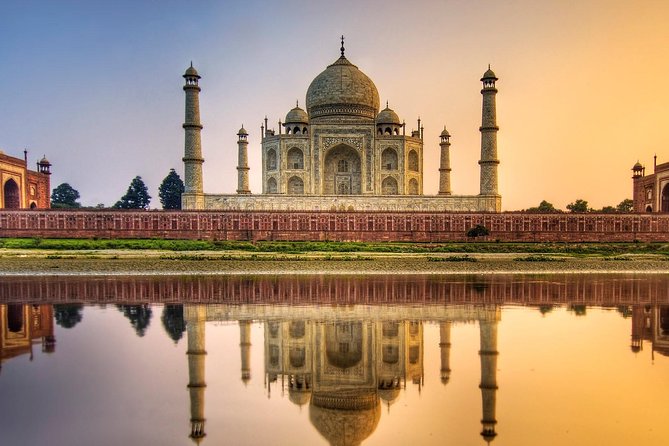
Then comes the Taj Mahal. Your time here is about 1 hour 30 minutes. This is the window that usually works best: enough time for photos, a guided walkthrough, and a chance to re-center when the crowd flow shifts.
Important practical note: Taj Mahal entry tickets are not included. That means you’ll want to budget for monument fees and be ready to pay on-site. Also, the Taj experience is very timing-sensitive in real life. If you’ve ever dealt with intense lighting, heat, and visitor flow, you already know why planning matters. This tour at least gives you enough time on-site to make the visit feel complete rather than rushed.
I also like that you’re not only seeing the Taj Mahal from afar. With a full-day built around Mughal sites, the Taj doesn’t feel like a random bucket-list stop. It feels like the end of a storyline.
Agra Fort and Itmad-ud-Daula on Day 3 before the Delhi drop
Day 3 keeps Agra from collapsing into just one monument. You start with Itmad-ud-Daula (sometimes called the Bachcha Taj in descriptions). The tour gives you about 40 minutes. This mausoleum is often described as a “jewel box” draft of the Taj Mahal, and that’s exactly why it works on the itinerary: it’s like seeing an earlier version of the visual language before you go back to the main masterpiece.
If you liked the Taj’s delicate detail, you’ll likely enjoy how this site rewards close attention. The time is short enough to stay energetic but long enough to slow down and notice the design elements a quick exterior pass would miss.
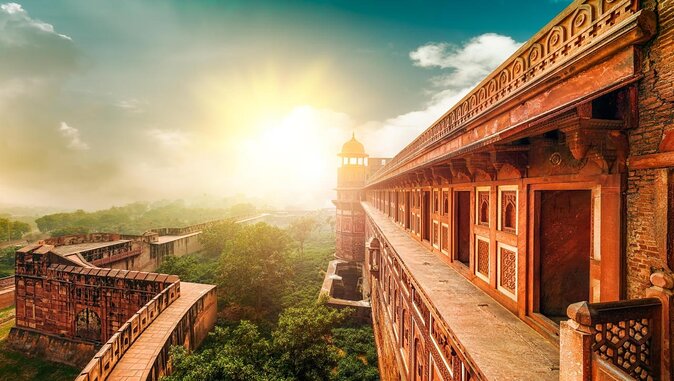
Then you visit Agra Fort, with about 30 minutes allotted. Agra Fort was a main residence of Mughal emperors until the capital shifted from Agra to Delhi. That time context matters because the fort doesn’t feel like a static ruin. It feels like a place where power moved, changed, and eventually left.
Agra Fort is also one of those sights where comfortable shoes help. You’re moving around historical structures, and you’ll appreciate having that private vehicle waiting afterward rather than dealing with city transit.
Drop at Delhi hotel or airport
At the end of the tour, you’re dropped in Delhi—either at your hotel of choice or at the airport. This is a major value point for a multi-city trip like this. Instead of you scrambling for another transfer plan right after the last monument, the tour wraps it up cleanly.
Included hotels, guides, and AC transport: why this setup feels easier
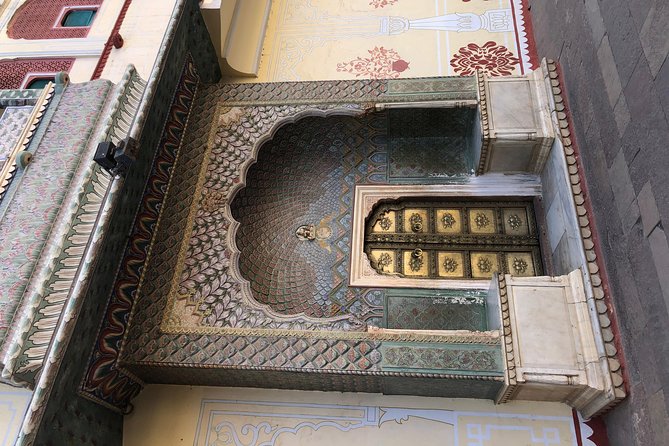
This is a private tour, meaning only your group participates. That usually translates into less waiting and fewer compromises about pacing. It’s also a time-saver in places like Jaipur and Agra, where monument schedules and visitor flow can throw off a DIY day.
A few practical inclusions matter more than they sound on paper:
- AC vehicle and driver: helpful in Rajasthan heat, especially between sites
- Bottled water: a small thing that prevents big “I’m not feeling well” moments
- Local guides in Jaipur, Fatehpur Sikri, and Agra: these are not generic narrators; they’re there for context
- Hotel pickup and drop-off: reduces the stress of finding meeting points in busy areas
Two included breakfasts and one included dinner
You get breakfast for two mornings and one included traditional dinner with an Indian family. That’s a nice trade: breakfast keeps you moving, and the dinner gives you cultural value beyond monuments.
Food and drinks at other times are not included unless specified, so you’ll still have freedom to eat what you like. I recommend planning for a mix: one meal you try locally and one meal that’s simple and quick, so you don’t spend your limited energy searching.
Price and value: does $187 per person make sense?
At $187 per person, this tour has a lot built into it: private transport, guides, and two nights of accommodation. Most budget travelers end up paying separately for a driver, a guide, hotels, and intercity transport. Here, those pieces are packaged.
The big caveat is also clear: monument entry fees are extra and paid directly. That’s common in India, but it affects your true total cost. If you’re budgeting tightly, treat the entry fees as a guaranteed add-on and not a surprise.
The other hidden-variable is your hotel tier. The program states the included accommodation is based on your selected 3-star, 4-star, or 5-star option. If you choose a higher tier, you’re paying more, but you’ll likely get more comfort during two nights that matter after long sightseeing days.
In plain terms: this is good value when you want a smooth, guided experience without the stress of building the route yourself.
What I’d pack and how I’d pace it
This tour covers forts, palaces, mausoleums, and a major step well. That means you want practical basics more than fancy gear.
I’d bring:
- Comfortable shoes for uneven stone and lots of walking
- A hat and sunscreen for daytime stops
- A light layer for early morning or indoor shade
Pacing advice: don’t try to collect photos of everything. Pick a few “must-have” shots in each stop and use the guide time to learn. The itinerary has enough built-in rhythm that you don’t need to sprint.
Also, remember the tour is private, so if anything feels too crowded on the day, you can ask your guide how to adjust your route within the allocated time.
Who this tour is best for
This fits well if you:
- Want a guided route from Jaipur to Agra with fewer decisions
- Prefer private comfort over shared shuttles
- Like cultural connections, not only monuments—especially the Jaipur family dinner
- Are short on time and still want the major highlights
It might not be the best choice if you want total freedom to linger at every site without time limits, or if you have a strict budget that can’t handle extra monument entry fees.
Should you book this Jaipur and Agra private tour?
Yes, if you want a structured, low-stress way to see Jaipur and Agra in three days with real local interpretation. The combination of included hotel nights, AC transport, and guides at the right places makes the trip feel efficient without turning it into an assembly line. The standout is the cultural payoff of the traditional dinner with a local family, and in some departures, even more personal involvement from the tour owner’s family side.
If you’re someone who hates paying separate entry fees, factor that in before you decide. Once you account for monument costs, the $187 price becomes much easier to justify for a private, multi-city package.
FAQ
How long is the Jaipur and Agra tour?
The duration is approximately 3 days.
Is pickup included?
Yes. The tour includes hotel pickup and drop-off.
Is this tour private or shared?
It’s private. Only your group will participate.
What’s included in the price besides the tour?
The price includes two nights of accommodation (based on 3-star, 4-star, or 5-star option), breakfast for two mornings, one traditional dinner with an Indian family in Jaipur, an AC vehicle with driver, bottled water, local guides at Jaipur, Fatehpur Sikri, and Agra, plus hotel pickup and drop-off.
Are monument entry fees included?
No. Monument entry tickets are not included and must be paid directly at the sites.
Where do I get dropped off at the end?
You’ll be dropped off in Delhi at the hotel of your choice or at the airport.
Does the tour include transport between cities?
Yes. All transport is provided in an air-conditioned vehicle with a driver, and transfer times are approximate based on traffic and time of day.
What time is the tour usually booked?
On average, it’s booked about 26 days in advance.
What’s the cancellation policy?
You can cancel up to 3 days in advance for a full refund. If you cancel less than 3 days before the experience starts, the amount paid is not refunded. Cancellation cut-off times follow the local time of the experience.