REVIEW · JAIPUR
2-Day Private Jaipur City Sightseeing Tour with Three Forts
Book on Viator →Operated by Pashmina Tours · Bookable on Viator
Two days, three forts, and zero hurry. I love the two-day pace and round-trip hotel pickup because it lets you see Jaipur’s big sights without turning your day into a sprint. The one thing to plan for is cost creep: monument entrance fees are not included (about $30 per person), and gratuity is extra.
This is set up as a private experience in an air-conditioned vehicle with bottled water, so the heat and traffic don’t fully run the show. Day 1 focuses on the pink-city center (Amer area down through City Palace and Jantar Mantar), and Day 2 shifts to the fort ring and classic photo stops like Hawa Mahal and the forts above the city.
In This Review
- Quick hits
- Why this two-day Jaipur route feels less rushed
- Day 1: Amer Fort to Jantar Mantar without turning it into a blur
- Amer Fort (Amer Palace) and the Hindu-Mughal blend
- Panna Meena ka Kund: a stepwell with real personality
- Jal Mahal photo stop: the Water Palace from the roadside
- City Palace: museum spaces inside the royal home
- Jantar Mantar: the observatory where math looks like art
- Day 2: Hawa Mahal photos, Jaigarh cannon views, and Nahargarh at golden hour-ish
- Hawa Mahal: quick “Palace of Wind” photo time
- Jaigarh Fort: hilltop fort views and artillery museum stops
- Nahargarh Fort: part of the defense ring
- Royal Gaitor Tumbas: cremation cenotaphs at the foothills
- What you’re really paying for: guide, vehicle, and the $30 entrance fees
- The private guide effect: flexible pacing and useful local know-how
- Practical tips before you go (so the heat doesn’t win)
- Should you book this 2-Day Private Jaipur City Sightseeing Tour with Three Forts?
- FAQ
- FAQ
- What is included in the tour price?
- Are entrance fees included for monuments?
- How much are the entrance fees?
- Does the tour include hotel pickup and drop-off?
- Is this a private tour?
- Is there a mobile ticket?
- How long is the tour?
- What is the cancellation policy?
- Is bottled water provided?
Quick hits
- Private, flexible format: your own group, with a guide who can adjust the tempo.
- Air-conditioned vehicle + bottled water: practical help for Jaipur’s daytime heat.
- Two days instead of one: more time at each stop, fewer “quick photo then run” moments.
- World Heritage hits: Amer Fort and Jantar Mantar are on the schedule.
- Three forts coverage: Amer (Day 1), Jaigarh + Nahargarh (Day 2).
- Add-on costs are expected: plan on monument entry fees.
Why this two-day Jaipur route feels less rushed
Jaipur looks compact on a map, but real life has traffic, lines, and the sun doing its own thing. I like that this tour gives you two full days to spread the stress out. You’re not forced to cram palace rooms and fort viewpoints back-to-back like a checklist.
The private setup matters too. In a crowded group tour, you often lose time to waiting and competing interests. Here, your guide can keep the flow calm and your schedule makes sense—especially on Day 2 when you’re bouncing between fort viewpoints and cemetery-temple architecture at Royal Gaitor.
Finally, the vehicle and water are not “nice-to-haves” in Jaipur. Having air-conditioning and cold bottled water lets you actually enjoy the stops instead of counting minutes until you’re back in the car.
You can also read our reviews of more city tours in Jaipur

Day 1: Amer Fort to Jantar Mantar without turning it into a blur
Day 1 is built around Jaipur’s royal core—palaces, observatories, and the water-and-stone stops that make this city feel like it has layers.
Amer Fort (Amer Palace) and the Hindu-Mughal blend
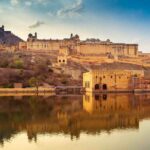
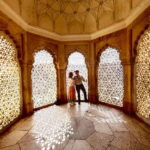
Your day starts with Amer Fort, a World Heritage site built by the Hindu Rajput kings in the 16th century. What I like about Amer is how it doesn’t feel like one single style. You get a blend of Hindu Rajput and Mogul-era influences, which makes the fort feel like it grew over time instead of being one static monument.
A key practical note: Amer Fort usually rewards patience. Even if you’re not a “fort person,” the place has enough courtyards and visual variety to keep attention—especially when your guide explains what you’re looking at instead of just pointing.
Admission isn’t included, so budget for the ticket before you go.
Panna Meena ka Kund: a stepwell with real personality
A few minutes away, you’ll stop at Panna Meena ka Kund, a 16th-century stepwell. This is one of those sites that’s quick on paper (about 20 minutes), but it’s memorable because it’s functional architecture with artistic design.
It’s free to enter, which is great value in the middle of a ticket-heavy day. If you enjoy geometry in buildings, or you just want a cool (temperature-wise) break from palaces and crowds, this stop is a winner.
Jal Mahal photo stop: the Water Palace from the roadside
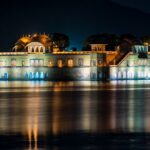
Next comes Jal Mahal, the Water Palace built in 1799 AD in the middle of water. This is listed as a short stop, and that’s realistic. You’re there mainly for views and photos rather than a long walk-through.
I treat Jal Mahal as a mental reset. You’re moving from fort and stepwell details into open-air city imagery, and it helps your eyes catch up before the big museum-prince moment at City Palace.
You can also read our reviews of more private tours in Jaipur



City Palace: museum spaces inside the royal home
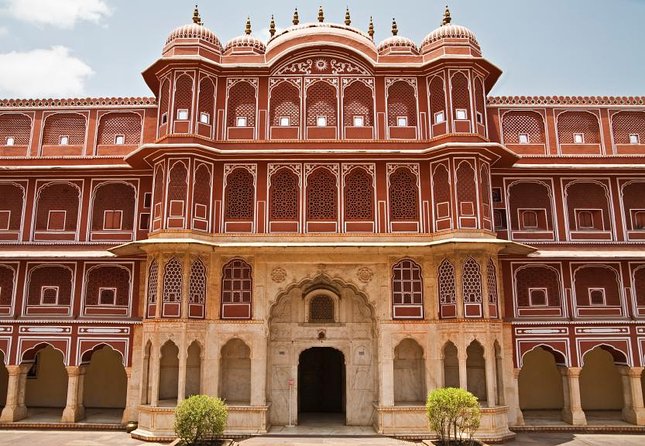
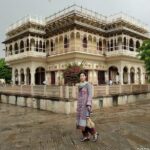
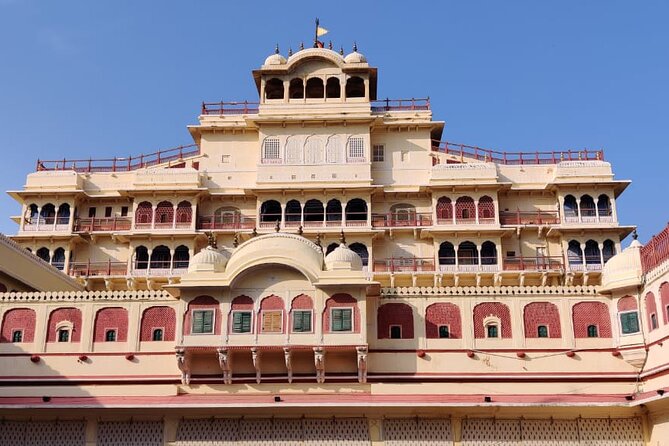
After a photo stop, you head into City Palace, a palace complex in the Pink City that was largely converted into a museum. You’re looking at the royal family’s Jaipur home, then at how parts of it became public space later.
This is one of those stops where a good guide really helps you get oriented quickly. You’ll want to know what matters most inside, where to stand for views, and how the palace reflects changing power over time. Admission is not included, so plan the ticket cost.
Jantar Mantar: the observatory where math looks like art
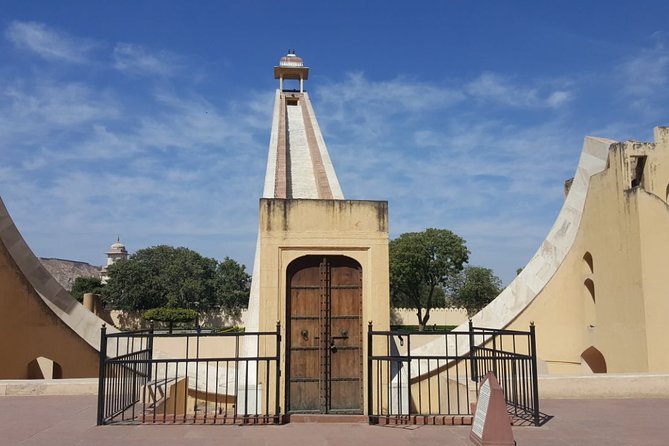
Day 1 closes at Jantar Mantar, another World Heritage site and an observatory built in the early 18th century by Jai Singh. You’ll see astronomical instruments used for astrology and astronomy, and it can feel a little like walking through giant science sculpture.
Time on this stop is brief on paper, but the key is your guide’s explanation. When someone frames what each instrument is for, Jantar Mantar stops being intimidating and becomes fun—like you’re decoding a building.
Admission isn’t included, so again: keep the money for tickets in mind.
Day 2: Hawa Mahal photos, Jaigarh cannon views, and Nahargarh at golden hour-ish
Day 2 is where the tour earns its name: three-fort energy, with Jaipur’s viewpoints and royal burial architecture.
Hawa Mahal: quick “Palace of Wind” photo time
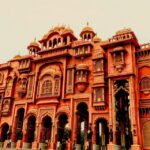
You start with Hawa Mahal, the iconic Palace of Wind built by Maharaja Sawai Pratap. Your stop is short and focused—mostly for photos.
This is a place where you’ll want to step back and look at the façade patterns. Even in a quick visit, you can spot why the building is famous: it’s designed to give windows and airflow for the royal ladies, and from the street it feels almost like a lacework mask.
Admission isn’t included, but it’s often less about buying time and more about getting the right angles.
Jaigarh Fort: hilltop fort views and artillery museum stops
Jaigarh Fort sits atop Cheel ka Teela, Hill of Eagles. It’s about 2 hours and that time makes sense: you’re on a hill, you want the views, and you’ll likely want to walk enough to feel the scale.
The fort is known for lavish palaces, courtrooms, triple arch gateways, temples, and military structures. One thing I think you’ll appreciate here is how Jaigarh feels like the fortress brain—different from Amer’s palace vibe.
Some guides also point out museum areas inside Jaigarh, including an artillery museum and display-model type exhibits. There’s also a famous cannon association that tends to get mentioned here, so if you like military tech and scale, this stop pays off. Admission isn’t included.
Nahargarh Fort: part of the defense ring
Next you’ll go to Nahargarh Fort, built as a guard over Jaipur for almost 300 years. It was once part of the defense ring that included Jaigarh and Amer Fort.
Your time here is about 1 hour. That’s enough to see why people come for the panorama. On a clear day, the fort views are the best “why Jaipur is worth it” moment of the tour. Even if you don’t climb far, the viewpoint angles can do a lot of work for your photos and your sense of place.
Admission isn’t included.
Royal Gaitor Tumbas: cremation cenotaphs at the foothills
You’ll finish at Royal Gaitor Tumbas, the cremation site of Rajasthan’s Maharajas located near the foothills of Nahargarh. The Royal cenotaphs are described as a blend of Islamic architecture and local styles, built over cremation sites.
This stop is 1 hour. It’s also a nice change of pace at the end of a fort-heavy day. Palaces and fortifications are loud visually; Royal Gaitor feels more reflective and architectural. If you’re interested in how power and royalty are remembered, this is a meaningful closer.
Admission isn’t included.
What you’re really paying for: guide, vehicle, and the $30 entrance fees
The base price is $99 per person, for a 2-day private route that includes pickup/drop-off in a private air-conditioned vehicle, bottled water, parking and fuel charges, and a professional guide.
That sounds straightforward because the big operational costs are already handled. For Jaipur, the value isn’t just “transport.” It’s the fact that you’re not negotiating routes, waiting for ticket lines alone, or trying to decode where to stand for the best photos.
Now the part you must budget for: entrance fees. Monument entry is not included, with a stated entrance fee of about $30 per person.
Also remember gratuity isn’t included. Many tours in India run on the expectation of tipping your guide and driver when the service is good, so if you’re trying to keep costs predictable, set aside a realistic amount.
If you only look at the headline price, it may feel cheaper at first. If you add entrance tickets (and tipping), the final number lands closer to what a full guided day should cost. I like being blunt with this so you can decide without surprise.
The private guide effect: flexible pacing and useful local know-how
A major reason this tour scores high is how the guide role shows up in real life, not just in theory.
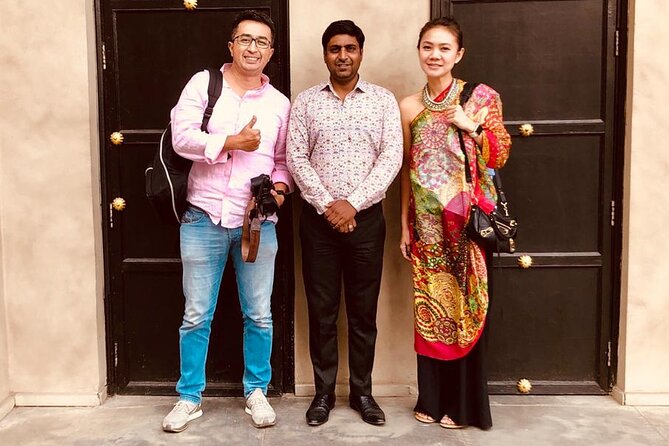
I’ve seen guides like Sanjay, Deepak, Kapil, Bhanu Pratap Singh, Raghu, and Sanjeev paired with drivers such as Kaan Singh, Prakash, Vinod, Krishna, and Thapa. Across these pairings, the consistent theme is communication and timing: staying on schedule, explaining what you’re seeing, and keeping you from getting stuck.
A few practical ways this can help you on the ground:
- If you’re sensitive to shopping pressure, ask your guide to help you handle it. One guide specifically warned about pushy salesmen at tourist sites, and that kind of heads-up can save you energy.
- If you care about photos, choose a guide who’s comfortable taking them. Several guides were praised for being great with cameras and setting you up for the right angle.
- If your group wants extra time somewhere, flexible pacing is the advantage of private touring. Multiple accounts describe guides as adaptable with schedule changes.
This isn’t just comfort. It affects the quality of what you remember. When you understand why Amer Fort looks the way it does, or what Jantar Mantar’s instruments were built to do, Jaipur stops being a background for photos and becomes a story.
Practical tips before you go (so the heat doesn’t win)
Jaipur can be demanding. Even with air-conditioning on transport, your time outdoors still counts.
Bring or plan for:
- Sunscreen, a hat, and sunglasses. You’ll be in photo zones and courtyard areas.
- Comfortable shoes with grip. Fort paths can be uneven.
- A small day bag for water and tickets (since monument entry fees aren’t included).
- A flexible attitude about walking. Forts are naturally more physical than palaces.
On timing, you’ll get a mix of longer stops (like about 2 hours at Amer Fort and Jaigarh Fort) and shorter photo breaks (like about 15 minutes at Hawa Mahal and Jal Mahal). So if you like a stop, don’t rush yourself just because the schedule is “short.” Ask for an extra few minutes at the end if the group pace allows.
And if you want the best photos, I suggest treating stops like Hawa Mahal and Jal Mahal as mini photo missions. Stand where your guide recommends, get your shots quickly, then relax. You’ll enjoy it more and won’t feel rushed.
Should you book this 2-Day Private Jaipur City Sightseeing Tour with Three Forts?
I’d book it if you have only a short time in Jaipur and you want the essentials plus the forts without getting exhausted. The two-day structure is the key advantage. One day is often too tight for Jaipur’s fort-to-palace rhythm, and this tour fixes that by spacing things out.
I’d also book it if you value a calm experience: hotel pickup/drop-off, an air-conditioned vehicle, and a guide who can explain what you’re looking at. That combination matters more than people think when traffic is heavy.
Don’t book it if you’re trying to do the entire thing as cheaply as possible. The entrance fees (around $30 per person) plus gratuity are extra, and you may still prefer a DIY plan if you’re comfortable organizing tickets and transport yourself.
FAQ
FAQ
What is included in the tour price?
Round-trip pickup and drop-off in a private air-conditioned vehicle, bottled water, fuel and parking fees, and a professional tour guide.
Are entrance fees included for monuments?
No. Entrance fee costs are not included in the price.
How much are the entrance fees?
The stated monument entrance fee is $30.00 per person.
Does the tour include hotel pickup and drop-off?
Yes. Round-trip transfers from your hotel are included.
Is this a private tour?
Yes. It’s private, and only your group will participate.
Is there a mobile ticket?
Yes. Mobile ticket is listed as part of the experience.
How long is the tour?
The duration is approximately 2 days.
What is the cancellation policy?
Free cancellation is available. You can cancel up to 24 hours in advance for a full refund.
Is bottled water provided?
Yes. Free bottled water is included during the tour.