REVIEW · JAIPUR
Full-Day Jaipur Sightseeing Tour by Car and Guide
Book on Viator →Operated by Alia Private Tours · Bookable on Viator
This is a great way to see Jaipur fast. You’ll move through the Pink City’s top landmarks in one full-day loop, from Hawa Mahal to the Amer Fort area, with time built in for photos and explanations.
What I like most: you get an air-conditioned private car with hotel pickup and drop-off, plus water and tea/coffee during the day. I also like that the route mixes the big-name monuments (City Palace, Jantar Mantar) with quieter stops like Royal Gaitor tombs and the stepwell Panna Meena ka Kund.
One thing to watch: several major sites have separate entrance fees, so your final total depends on which ones you choose to enter that day.
In This Review
- Key points that make this tour worth your time
- How the 8-hour Jaipur route stays efficient (and comfortable)
- Price and entrance fees: what you’ll pay in the real world
- Hawa Mahal first: a quick intro to Jaipur’s iconic facade
- City Palace courtyards: where the Old City’s power feels tangible
- Jantar Mantar: 19 instruments and the science behind the stone
- Royal Gaitor tombs: the quieter stop with strong architecture
- Jal Mahal: a lake-side pause that’s short by design
- Amer Fort area: the big viewpoint-heavy payoff
- Panna Meena ka Kund: the stepwell you’ll remember
- Albert Hall Museum: your final culture hour
- The service factor: why Ayub Khan (and Sethi) come up again and again
- Who this Jaipur car-and-guide day suits best
- Should you book this Jaipur full-day tour?
- FAQ
- Is pickup and drop-off included?
- What’s included in the tour price?
- What entrance fees are not included?
- How long is the tour?
- What about meals?
- Does weather affect the tour?
Key points that make this tour worth your time
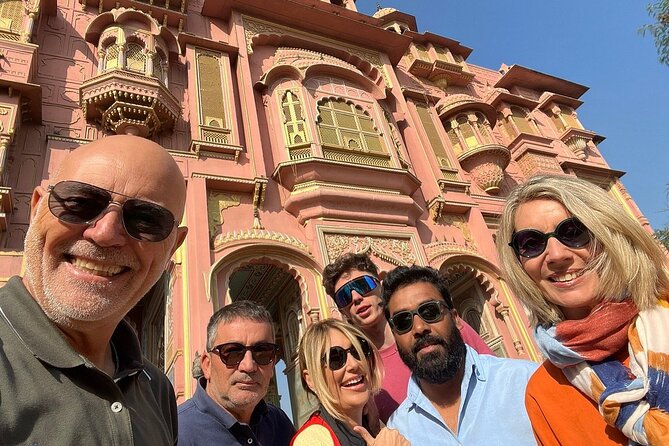
- Private car, not a cattle-cart: you ride in an air-conditioned sedan or SUV with hotel pickup and drop-off.
- A route that hits the essentials: Hawa Mahal, City Palace, Jantar Mantar, Jal Mahal, Amer, Panna Meena ka Kund, plus Albert Hall Museum.
- Photo-friendly variety: facades (Hawa Mahal), skyline views and stonework (Amer), and geometric architecture (Jantar Mantar, stepwell).
- The service reputation is strong: Ayub Khan is repeatedly praised for punctual, calm, helpful guidance; Sethi is also mentioned in feedback as a great match for short stays.
- Fast but not frantic: you get set time windows per stop (for example, 45 minutes at Hawa Mahal and Jantar Mantar, 2 hours at City Palace).
How the 8-hour Jaipur route stays efficient (and comfortable)
This is built for a full-day sight plan without you doing the hard work of transportation. The tour includes pickup and drop-off from your hotel in Jaipur, and you’ll travel in an air-conditioned mid-size sedan or SUV. That matters because Jaipur traffic and distance can turn a “quick city day” into a long headache.
The day runs about 8 hours. The pacing is practical: big monuments get the longer blocks (like City Palace at 2 hours), while quick-impact photo stops get shorter windows (like Jal Mahal at 15 minutes). You’re not left guessing how much time you’ll have at each site.
If you select a professional guide, you’ll have someone to explain what you’re looking at while you’re there—useful in Jaipur because the monuments can feel overwhelming when you’re staring at stone details without the context. Even when you’re not doing a full narration at every stop, the car + guide setup keeps you moving smoothly.
One more small but real comfort: bottled water and tea or coffee are included. Jaipur heat is no joke, and those breaks keep the day feeling human.
You can also read our reviews of more guided tours in Jaipur


Price and entrance fees: what you’ll pay in the real world
The base tour price is listed as $27.23 per group (up to 2), and it’s structured for small groups. That can be good value if you’re traveling as a couple or with one companion, because you’re essentially paying for private transport rather than splitting a large group bus.
But the day’s price is not just the headline. Entrance fees are not included for several key sights. Here are the fees listed as not included (per person):
- City Palace: ₹700
- Hawa Mahal: ₹250
- Jantar Mantar: ₹200
- Albert Hall Museum: ₹250
- Jaipur Fort: ₹500
- Royal Gaitor: ₹50
Some stops show as free in the stop details: Jal Mahal (free, 15 minutes) and Panna Meena ka Kund (free, 30 minutes). Also, Amer is listed as “Admission Ticket Free” in the stop info, but the not-included section separately mentions Jaipur Fort at ₹500 per person. In practice, this means you should confirm on the day what ticket category applies to the Amer/Fort entry you’ll use. You don’t want an awkward moment at the gate.
My advice for budgeting: plan on entrance fees adding up, especially if you want City Palace + Jantar Mantar + Hawa Mahal + Albert Hall Museum. If you’re trying to keep costs low, you can still get strong value from the outdoor views and the walking-time stops—especially Hawa Mahal’s facade—while deciding which interiors feel worth it.
Hawa Mahal first: a quick intro to Jaipur’s iconic facade

You start at Hawa Mahal, the Palace of Wind, with about 45 minutes at the stop. The facade is made from pink and red sandstone and sits right at the edge of the City Palace complex. This isn’t just a pretty wall. Those windows were built as a way to let light and air move through the structure, and the layout is tied to the zenana, the women’s quarters.
What I like about putting Hawa Mahal early: it helps you “get your bearings” before you move deeper into Jaipur’s palace and astronomy stories later. It also gives you time to photograph the exterior before the day gets longer and brighter.
The potential drawback: the ticket for Hawa Mahal isn’t included, so you’ll have to decide whether to pay to go in versus focusing on exterior viewpoints and the architectural rhythm of the facade. Either way, it’s a strong start.
City Palace courtyards: where the Old City’s power feels tangible
Next you’ll spend around 2 hours at City Palace in the center of the Old City. This place is a complex of courtyards, gardens, and buildings, not one single hall. That makes your time here more flexible: you can move at a comfortable pace, linger where details catch your eye, and still cover enough ground.
The outer wall connects to Jai Singh II, while the palace inside was enlarged and adapted as the centuries went on. In other words, this isn’t just one era of royal life—it’s layered.
What to watch for during your visit: courtyard scale. City Palace can feel like “a lot” when you first enter, but the courtyards give you breathing room and help you understand the palace as a functioning space—open areas surrounded by rooms and passages.
The main drawback is time and money. The entrance fee for City Palace is ₹700 per person and the stop is one of the longer ones. If you’re short on energy, arrive with a plan: pick a few areas you care about and let the rest be a slow wander rather than a checklist.
Jantar Mantar: 19 instruments and the science behind the stone
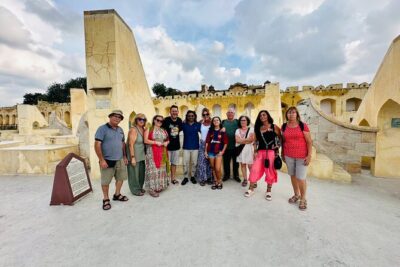
Then you’ll head to Jantar Mantar for about 45 minutes. This is the part of Jaipur that feels surprising if you only expect palaces and forts. Jantar Mantar is a collection of nineteen architectural astronomical instruments built by Sawai Jai Singh II, and it was completed in 1734.
The wow-factor here is that the buildings aren’t random—they’re meant to measure and track celestial movements. If you’ve got a guide, this is one of the stops where explanations can genuinely change what you notice. Even without a guide, you can still get a lot out of the main shapes and how people use the space to read the sky.
The drawback: the ticket for Jantar Mantar is not included (₹200 per person). If you’re trying to save money, prioritize this over less story-driven stops, because it’s so distinct from the rest of the day.
You can also read our reviews of more tours and experiences in Jaipur





Royal Gaitor tombs: the quieter stop with strong architecture
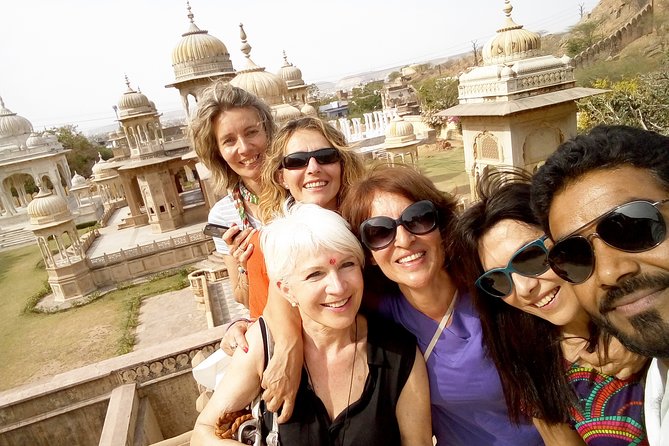
You’ll get another 45 minutes at Royal Gaitor tombs, also known as Gaitore Ki Chhatriyan. This is described as one of the lesser-explored attractions in Jaipur, and that’s a real advantage. You’re not competing with a wall of tour buses the whole time, so you can take your time with photos and details.
This stop is all about architecture. The tombs and chhatriyan (the small domed pavilion forms) create a repeating pattern that photographs well and rewards slow looking.
The main consideration: it has a small entrance fee listed as ₹50 per person for Royal Gaitor, and it’s not the most famous name on the itinerary. If you hate spending money on “maybe” stops, weigh this against what you most want to see indoors that day.
Jal Mahal: a lake-side pause that’s short by design
Jal Mahal is next, with only 15 minutes allocated—and that’s intentional. The palace sits in the middle of Man Sagar Lake, and it was renovated and enlarged in the 18th century by Maharaja Jai Singh II.
Because time is short here, I treat Jal Mahal as a breath-break and photo moment rather than a long visit. The payoff is the visual: the contrast between the palace structure and the water setting is what makes people stop.
Good to know: no entrance fee is listed for this stop, and it’s free in the tour details. The practical downside is that with just 15 minutes, you won’t get a slow walk around the full area. If you want more time, you’d need separate planning after the tour.
Amer Fort area: the big viewpoint-heavy payoff
Amer is one of Jaipur’s top attractions, and you’ll have 2 hours here. It sits atop a small hill about 11 km from the main city. That hill position is the reason the fort area often feels dramatic—your arrival and the views make it feel like a big moment.
The tour also points toward the “Jaipur Fort” entrance fee as not included (₹500 per person). Meanwhile, the stop detail for Amer says admission ticket free. Since those two notes don’t perfectly match, I strongly suggest you confirm at pickup or with your driver-guide what entry ticket you should plan for—especially if you’re counting on visiting interior sections.
How to make the most of Amer within a time window:
- Go slow near the viewpoint areas so you don’t rush past the best angles.
- Leave time at the end for photos rather than only trying to “cover everything” immediately.
- If you have a guide, ask them what’s most important to see first so your limited hours don’t turn into aimless wandering.
This stop is often the hardest part to “fake” with time. If you love forts and palaces, this is where the day earns its keep.
Panna Meena ka Kund: the stepwell you’ll remember
Next is Panna Meena ka Kund, a stepwell with a 30-minute time block. This isn’t a quick “look and leave” stop. It’s an eight-story structure, about 200 feet deep, with 1,800 symmetrical steps, and it’s believed to have been constructed in the 16th century.
This is the kind of place where architecture and geometry become practical. The steps create patterns, and the depth makes your perspective change as you move. Even if you’re not a hardcore architecture person, you’ll likely find it easy to stay engaged because it’s visually structured in a way that’s fun to explore.
The best part: it’s listed as free in the tour details, so you’re getting a high-impact photo and walking location without another ticket cost.
My only caution: bring water or use the included bottled water. Stepwell areas involve walking and stairs.
Albert Hall Museum: your final culture hour
You’ll close with Albert Hall Museum for about 1 hour. This museum is a “must-visit” style stop for Rajasthan history and culture, and it has collections that include artifacts, sculptures, paintings, and more.
This final hour is smart because it gives you a different pace after the outdoor monuments. If you’re the type who likes to connect what you saw in the streets to objects behind glass, this is a good way to end.
The drawback: the museum entrance fee is listed as ₹250 per person and is not included. If you find you’re tired toward the end, you can treat this as optional depending on how you feel—your driver-guide can usually help you decide what’s worth the entry based on time.
The service factor: why Ayub Khan (and Sethi) come up again and again
A huge reason this tour works is the human side. In the feedback you provided, Ayub Khan is repeatedly praised for being patient, informative, and professional—plus for keeping things calm when travel times get messy. One story includes Ayub picking people up at Jaipur Airport at 2:00 am after a long journey, and the theme across messages is that he shows up on time and stays helpful.
There are also mentions of the driver being attentive to what to watch for, and one person noted that the team was willing to handle deviations when needed. That kind of flexibility matters on a full-day schedule, because Jaipur doesn’t run like a theme park. Things change—traffic, crowds, and your own energy.
One more praise point that’s practical: a clean, comfortable vehicle and guidance on where to eat or find souvenirs. Even if you don’t shop, those recommendations can save time and hassle.
If you’re nervous about navigating Jaipur on your own, this is the reassurance: you’re not just buying a route. You’re buying someone’s on-the-ground judgment.
Who this Jaipur car-and-guide day suits best
This tour is a strong match if:
- You’re seeing Jaipur for the first time and want the headline sights in one day.
- You prefer a private car with pickup and drop-off instead of public transport juggling.
- You want a mix: palace architecture, outdoor landmarks, and at least one museum stop.
- You like having a guide to explain details, especially at City Palace and Jantar Mantar.
It might be less ideal if:
- You already know you only want a couple of stops and hate paying for extras like museum entries.
- You plan to move fast with no patience for tickets, lines, or walking time.
- You’re sensitive to long days. This is about 8 hours, and you’ll be on the move throughout.
Also keep weather in mind. The experience is noted as requiring good weather. If conditions are poor, you may be offered a different date or refund.
Should you book this Jaipur full-day tour?
If you’re traveling as a small group (up to 2) and you want an efficient, guided day focused on top Jaipur monuments, this is an easy yes. The big value isn’t just the sights—it’s the private transport, air-conditioning, included water/tea/coffee, and the service quality tied to drivers like Ayub Khan (and also Sethi in some cases).
The smart decision comes down to budgeting for entrances. If you’re willing to pay the site fees where it counts, the day feels well built. If you want maximum savings, you’ll still get good outdoor impact, but you’ll need to be selective about what you enter.
Overall: book it if you want a smooth Jaipur day with minimal planning stress and real guidance behind the monuments.
FAQ
Is pickup and drop-off included?
Yes. The tour includes hotel pickup and hotel drop-off in Jaipur, plus bottled water and tea or coffee during the day.
What’s included in the tour price?
Transport by air-conditioned mid-size sedan or SUV, hotel pickup/drop-off, fuel surcharge and parking/taxes, water and tea or coffee, and a professional tour guide if selected. Mobile ticket is included.
What entrance fees are not included?
Entrance fees are listed as not included for City Palace (₹700), Hawa Mahal (₹250), Jantar Mantar (₹200), Albert Hall Museum (₹250), Jaipur Fort (₹500), and Royal Gaitor (₹50). Jal Mahal and Panna Meena ka Kund are shown as free in the stop details.
How long is the tour?
It’s listed as approximately 8 hours for the full day.
What about meals?
Meals are not included.
Does weather affect the tour?
Yes. The experience requires good weather, and if it’s canceled due to poor weather you’ll be offered a different date or a full refund.